

Yuval Noah Harari’s Sapiens: A Brief History of Humankind offers an expansive and engaging exploration of the evolution of Homo sapiens, taking readers on a journey from our early beginnings to our current status as the dominant species on Earth. Harari’s narrative blends history, science, and philosophy, providing a thought-provoking analysis of what it means to be human.
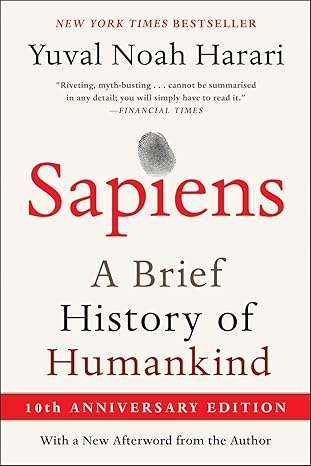
Sapiens begins with the Cognitive Revolution, which occurred about 70,000 years ago. This period marked a pivotal point in human history when our ancestors developed complex language and abstract thinking. Harari argues that these cognitive advancements allowed Homo sapiens to outcompete other species and form large, organized societies.
The book then transitions to the Agricultural Revolution, a time when humans shifted from a nomadic lifestyle to farming and settling in permanent communities. Harari offers a critical perspective on this transition, suggesting that while agriculture enabled the growth of civilizations, it also introduced new challenges, such as social hierarchies and environmental impact.
As the narrative progresses, Harari examines the unification of humankind through the development of shared myths, religions, and economic systems. These shared beliefs and structures, according to Harari, played a crucial role in the formation of large-scale societies and global empires.
In the final sections, Harari explores the Scientific Revolution and the rise of capitalism and industrialization. He delves into the impact of scientific discovery on human progress and raises questions about the future, particularly in light of emerging technologies like artificial intelligence and genetic engineering.
One of the standout features of Sapiens is Harari’s ability to challenge established narratives and encourage readers to think critically about human history. He presents controversial ideas, such as the notion that the Agricultural Revolution may have led to a decline in overall human well-being or that capitalism functions as a modern religion.
Harari’s writing is accessible and engaging, making complex concepts easy to understand. He skillfully draws on examples from a wide range of disciplines to support his arguments, ensuring that the book is both informative and entertaining.
At its core, Sapiens is a book that tackles fundamental questions about human existence: What defines us as a species? How did we come to dominate the planet? Where might we be headed? While Harari doesn’t provide definitive answers, he offers a framework for considering these questions from new perspectives.
Some readers might find Harari’s outlook to be somewhat pessimistic, but others will appreciate his willingness to address difficult truths. By questioning long-held beliefs about progress and human nature, Harari invites readers to reassess their understanding of history and the future.
Sapiens is a compelling and intellectually stimulating book that appeals to readers interested in history, anthropology, and the future of humanity. Harari’s ability to weave together diverse topics into a cohesive narrative makes this book a must-read for anyone seeking to deepen their understanding of the human journey.
Whether you agree with all of Harari’s viewpoints or not, Sapiens is sure to spark reflection and discussion long after you’ve finished reading. It’s a book that challenges us to rethink our past and consider the implications for our future—a challenge that is increasingly relevant in today’s world.